Social media is often the first place people go to interact with a brand, whether to ask a question, give praise, or lodge a complaint. Knowing how to respond appropriately and consistently is essential for building trust and maintaining a positive online reputation.
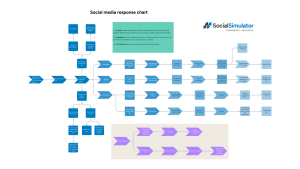
This article distills a helpful social media response flowchart into actionable steps, offering a simple framework for handling interactions across platforms.
🧭 Step 1: Understand the nature of the message
Start by asking yourself: What is this person saying?
Are they:
Being kind or complimentary?
Asking a question?
Making a complaint?
Sharing an accusation or concern?
Posting abusive or inappropriate content?
Your next step depends entirely on the tone and purpose of their message.
When a user is friendly or positive, use it as an opportunity to engage and strengthen the relationship.
✔️ If they’re giving praise:
Thank them sincerely.
Consider resharing their post or amplifying their voice.
✔️ If it’s a neutral comment:
Acknowledge the message.
Use it to spark a friendly interaction or add value to the conversation.
❓ Questions: Know when to answer or escalate
✔️ If you know the answer:
Respond clearly and publicly.
If the answer is too long, link to a relevant webpage for more information.
🚧 If you don’t know the answer:
Use a holding message (“Thanks for your question, we’re looking into it”).
Escalate internally and aim to follow up quickly.
If needed, take the conversation offline for a deeper discussion.
😡 Complaints, accusations, and attacks
Negative comments need careful handling to show that your brand listens and cares, even when under fire.
🧠 General rule:
Always show empathy and try to understand the user’s frustration.
Where possible, publicly demonstrate that you're taking action.
⚠️ Examples:
Complaint: “I stayed in all day and my delivery didn’t arrive.” “I’m sorry to hear that. What’s your order number so I can look into it?”
Accusation: “You’re the worst company!” “I’m sorry you feel that way. Has something specific caused your frustration?”
Critical feedback: “Your product contains palm oil.” If true, acknowledge it and show your intent to address the issue. If false, calmly rebut with accurate information and a link.
🔄 After 2–3 responses:
If the issue is still unresolved or emotions are high, move the conversation offline or offer to follow up via private channels.
🚨 When to escalate or report
For more serious concerns:
Spam, swearing, confidential data, or abuse: ➤ Hide or delete the comment. ➤ Take screenshots. ➤ Block the user if necessary. ➤ Escalate internally and, if appropriate, report the user to the platform or authorities.
Security threats or sensitive issues: ➤ Flag the situation immediately to the relevant internal team. ➤ Do not engage publicly.
🧰 Use the P.E.A. framework
A simple but powerful reminder for every interaction:
P – Prepare Have stock responses ready for FAQs or known sensitive issues. Draft messages for dealing with rule-breaking users.
E – Empathise Assume good intent and try to understand the context behind a user’s frustration or question.
A – Act Human Avoid sounding robotic. Use a conversational tone and show there’s a real person behind the screen.
🎯 Final thoughts
Not every social media interaction needs a perfectly crafted response, but every response should be thoughtful. By listening, showing empathy, and acting human, you can turn even a complaint into an opportunity to demonstrate your brand's values.
We use technologies like cookies to store and/or access device information. We do this to improve browsing experience track the performance of our ads. Consenting to these technologies will allow us to process data such as browsing behavior or unique IDs on this site.
Functional
Always active
The technical storage or access is strictly necessary for the legitimate purpose of enabling the use of a specific service explicitly requested by the subscriber or user, or for the sole purpose of carrying out the transmission of a communication over an electronic communications network.
Preferences
The technical storage or access is necessary for the legitimate purpose of storing preferences that are not requested by the subscriber or user.
Statistics
The technical storage or access that is used exclusively for statistical purposes.The technical storage or access that is used exclusively for anonymous statistical purposes. Without a subpoena, voluntary compliance on the part of your Internet Service Provider, or additional records from a third party, information stored or retrieved for this purpose alone cannot usually be used to identify you.
Marketing
The technical storage or access is required to create anonymous user profiles for advertising purposes, or to track the user on a website or across several websites for similar marketing purposes.